
Your First Month in a New UK Job: A Ruthless Playbook
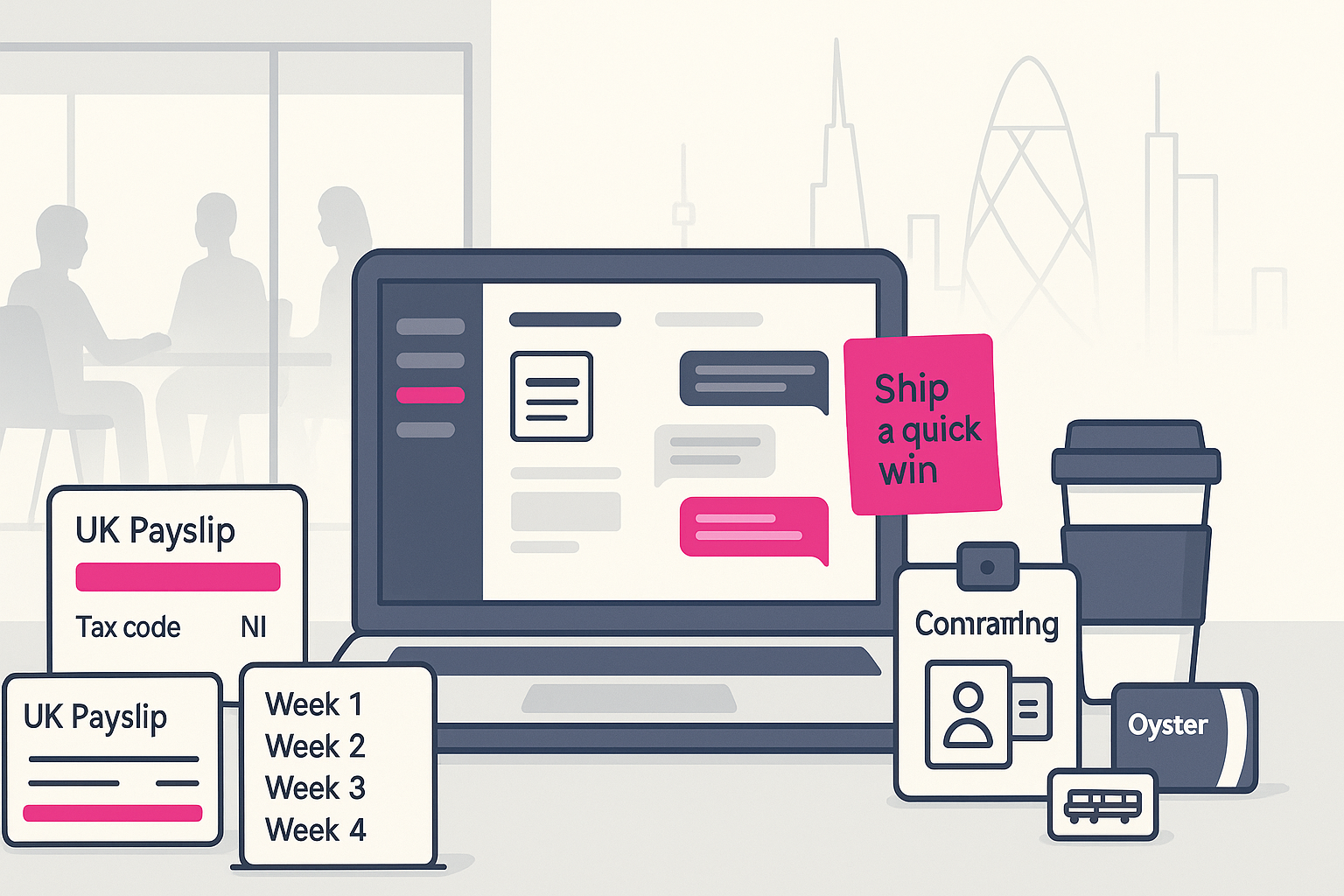
You’ve signed the contract. The laptop’s on, Teams is pinging, and the probation clock has started. In the UK, your first month isn’t a warm-up. It is your reputation, your trajectory and your leverage, set in 30 days. Ship value fast, master expectations, and avoid the silent errors that kill trust. That’s the job. This playbook shows you how.
The first-month UK reality check
Here is what the UK context adds to your day one-to-30:
- Probation period: Standard in the UK, often three to six months. It is a genuine test. Terms are in your contract. Read them. ACAS guidance expects proper induction and regular reviews.
- Contract and handbook: Working hours, notice, confidentiality, restrictive covenants, social media, gifts and expenses. These are not decorative. Live within them.
- Working Time and leave: You accrue holiday from day one under Working Time Regulations. Bank holidays vary by employer policy. Check how leave is approved.
- Payroll specifics: Check your tax code on your first payslip. Emergency codes happen. Fix errors fast via HMRC. Confirm National Insurance number, student loan plan, pension auto-enrolment and any salary sacrifice.
- Hybrid on-site rules: Office days, desk booking, travel expense thresholds, IT security in public spaces. Follow them precisely.
- Right to work: Ensure HR has verified documents correctly. If visas are involved, know the conditions.
- Performance rhythms: One-to-ones, stand-ups, sprint reviews, pipeline meetings, weekly business reviews. Map them by week one. Show up prepared.
- Information protection: UK GDPR and confidentiality clauses apply to everything you see, hear or export. Keep data in sanctioned systems. Ask before sharing.
A week-by-week playbook for your first 30 days
Week 1: Orient, learn, de-risk
Your goal isn’t to impress with big ideas. It is to cut uncertainty.
- Lock down essentials: Laptop, systems access, MFA, calendars, org chart, policy links, expense tools, HR portal, learning platforms.
- Confirm basics with HR: Payroll dates, tax code, NI, pension staging date, benefits start, leave booking. Spot and flag any errors immediately.
- Book manager cadence: Set a weekly 45-minute one-to-one. Share your draft month-one objectives by day 3.
- Map stakeholders: Who depends on you, and whom you depend on. Get 6 to 10 short intros in the diary. Focus on customers, operations, finance, and your team’s adjacent partners.
- Define the scoreboard: What are the top three outcomes your manager is judged on this quarter? How does your role move those numbers?
- Learn the product and customer: Sit in on calls. Review last quarter’s wins, losses, NPS or CSAT, and the support queue. See the truth, not the brochure.
- Adopt communication norms: Email for decisions. Teams or Slack for fast progress. Use clear subject lines, action bullets, and owner with deadline on every task.
- Identify a safe quick win: Low risk. Visible. Valuable. Example: fix a broken report, tidy the handover doc, close a nagging ticket, or standardise a template.
Week 2: Align on outcomes and ship something
The best onboarding signal is launched value.
- Agree your objectives: Convert your draft into 3 to 5 SMART goals spanning delivery, learning and relationship outcomes. Confirm in writing.
- Ship a quick win: Done by end of week. Announce it in the right channel with before and after and a measurable improvement.
- Build your operating rhythm: Time-block deep work, customer touchpoints, admin and review. Protect thinking time.
- Clarify definitions of done: For each task, write acceptance criteria. Share before you start.
- Learn the numbers: Revenue model, cost drivers, unit economics, SLAs. Ask finance for a 20-minute walkthrough.
- Establish feedback loops: Midweek pulse with your manager. Two peers you trust for fast feedback. A customer or internal user for real-world input.
Week 3: Compound trust with small wins
Consistency beats heroics.
- Layer improvements: Document one process. Automate one step. Clean one dataset. Reduce one recurring error.
- Publish operating notes: A one-page guide on what you do, how to engage you and your response times. Reduces noise. Increases trust.
- Strengthen cross-team ties: Ask one partner team what slows them down. Fix one thing you own or can influence.
- Evidence your impact: Track time saved, errors reduced, tickets cleared, cycle time improvements, revenue supported. Use simple before and after.
- Reality-check bandwidth: If workload is spiking, renegotiate scope early. Do not hide. Do not hope.
Week 4: Prove you belong and ask for feedback
You are building a case for passing probation. Show it, do not say it.
- Present a 30-day review: One slide per area: outcomes, learning, relationships, risks, requests. Keep it factual.
- Lock next 30-day goals: Prioritise two impactful deliverables and one capability build. Confirm resourcing and dependencies.
- Ask for hard feedback: What should I stop, start, continue? Where am I at risk of missing expectations?
- Capture testimonials: Short notes from a customer, peer or partner on what improved. Bank them.
Master one-to-ones and expectations
You win your first month by managing the manager relationship.
- Set the agenda: Use the same structure every week so you both relax into predictable decisions.
- Share progress artefacts, not vibes: Short written updates with metrics and blockers beat chatty status.
- Debate trade-offs openly: Your job is to surface choices, not carry silent load.
Suggested one-to-one agenda
- Top three outcomes this week: status, metrics, next step
- Decisions needed: options, recommendation
- Risks and dependencies: exposure, mitigation
- Learning and support: what you’re building, what you need
- Next week focus: two to three priorities and time cost
Message your manager today
Subject: First 30 days plan and 1:1 cadence
Hi [Name], I’ve drafted three focus outcomes for my first month and proposed weekly one-to-ones to keep us aligned. Can we review and lock these this week? I’ll send a one-pager with goals, metrics and risks by tomorrow. Thanks, [You]
Communication standards that build trust in UK teams
Write and speak like a professional who respects time.
- Response time: Acknowledge within working hours. Same day for quick asks, 24 hours for longer items. If you need more time, say when you’ll reply.
- Emails: Clear subject, one decision per thread, bullets, bold keywords sparingly, owners and dates. Attach the doc. Do not bury it.
- Teams or Slack: Default to public channels for work. Keep threads tight. Summarise outcomes. Avoid DM-only problem solving.
- Meetings: Decline if there is no agenda. Open with desired outcome. Close with owner and date for each action.
- Stand-ups: Speak in outcomes, not activities. What moved the metric? What is blocked? What is next with by when?
- Notes and records: If it is not written, it did not happen. Write the decision log. Share it.
- Remote etiquette: Camera on for small groups unless stated. Mute when not speaking. Share your working hours in your profile.
Deliver visible value quickly
Small, boring improvements create disproportionate goodwill. They also survive audits.
Quick wins most roles can find
- Process: Remove redundant approvals. Merge duplicate steps. Create a single source of truth page.
- Data hygiene: Fix a stale dashboard filter. Add data definitions. Eliminate a manual copy-paste.
- Customer clarity: Write a one-page FAQ for common issues. Reduce email back-and-forth.
- Templates: Standardise a proposal, report, sprint template or handover doc that saves 10 minutes per use.
- Risk reduction: Document an informal practice. Close the gap between what people do and what policy says.
- Internal comms: Summarise a long thread into a decision memo the team can use.
How to choose the right quick win
- Must matter: Ties to a team KPI, SLA, cost or risk.
- Must be visible: Others feel it or see it weekly.
- Must be shippable: You can deliver in 3 to 7 days without waiting on five approvals.
Understand the business model and customer
If you cannot explain how the organisation makes money and why customers choose it, you will waste your first month.
Key questions to ask
- What problem do we solve, for whom, and why do they pay us rather than someone else?
- What is our core revenue model? Subscription, project, licence, usage, margin on goods?
- What are our cost drivers and constraints? People time, suppliers, compliance, infrastructure?
- What are our leading indicators? Pipeline coverage, activation rate, on-time delivery, churn risk?
- What are our non-negotiable promises? SLAs, uptime, response times, compliance controls?
Where to find answers fast
- Sales or account review decks from the last two quarters
- Product roadmap and release notes
- Support or service queue reports and top issue categories
- Finance 101 overview or budget vs actuals
- Customer interviews or recorded calls
Culture, politics and integrity
Ignore politics entirely and you will get blindsided. Over-index on it and you will lose credibility. Navigate with integrity.
- Map influence, not just titles: Who actually decides? Who blocks? Who implements?
- Observe before you optimise: Learn the informal rules. Who gets praised and why? How do decisions really get made?
- Choose transparency: Share your reasoning. Invite disagreement. Document decisions in the open.
- Never trade integrity for speed: Respect confidentiality. Disclose conflicts. Say no to shortcuts that breach policy.
- Build social capital without being needy: Offer help. Credit others. Show up on time. Follow through.
Avoid UK HR and legal landmines
You are responsible for knowing the basics. Ignorance is not a defence.
- Data protection: Handle personal data per UK GDPR and your policy. Use approved tools. Encrypt sensitive files. Delete responsibly.
- Social media: Do not post about internal matters. Do not argue with customers online. Follow the handbook.
- Confidentiality and IP: Your contract binds you. Do not take documents to or from previous employers. Ask legal if in doubt.
- Expenses and gifts: Know thresholds, approvals and receipt rules. Declare gifts and hospitality as required.
- Health and safety: Follow risk assessments. Report hazards and incidents.
- Side work: Declare secondary employment or freelancing if the policy requires it. Avoid conflicts of interest.
- Time and attendance: Record hours accurately if relevant. Do not backfill dishonestly.
- Probation reviews: Expect structured check-ins. If you are not getting them, ask for them. ACAS encourages regular review and fair process.
Self-management in month one
If you run out of energy, you run out of options. Protect your capacity.
- Commute reality: Test your route both ways at working hours. Plan buffers. Late is loud in month one.
- Routines: Sleep, food, movement. Consistency beats intensity. Protect your mornings.
- Calendar control: Block deep work. Avoid back-to-back meetings. Put admin in low-energy slots.
- Information diet: Mute noisy channels. Unsubscribe from low-value email. Keep a personal decision log.
- Impostor feeling: Normal. Counter it with shipped work and clear feedback.
- Support: If your employer has an EAP or mental health support, know how to access it.
Scripts and templates you can use today
Intro message to your team
Hi all, I’m [Name], joining as [Role]. For month one I’m focused on [top two outcomes] and learning [product or process]. If I can make your work easier in any way, please tell me. My normal hours are [hours], office days [days]. Looking forward to working with you.
Stakeholder intro request
Subject: Quick intro and a small ask
Hi [Name], I’m new in [team]. I think our work connects at [point]. Could we do 20 minutes this week? I want to understand what success looks like for you and where my role can remove friction. Thanks, [You]
Weekly written update to your manager
Subject: Week [X] update and next focus
Progress: [three bullets with outcomes and metrics]
Blockers: [two bullets with risks and asks]
Next week: [two to three priorities with dates]
Support: [what you need]
Quick win announcement
Subject: Reduced [problem] by [X]% through [change]
Before: [baseline metric or pain]
After: [improved metric]
Impact: [time saved, errors reduced, value created]
Next: [follow-on improvement]
One-slide 30-day review structure
- Outcomes: what shipped, metrics, evidence
- Learning: product, process, policy, customer
- Relationships: key stakeholders engaged and outcomes
- Risks: what could derail next month
- Requests: decisions, resources, introductions
High-signal questions to ask your manager
- What would make you say my first month has been a success?
- Where do new starters often waste time here?
- What decisions are you currently losing sleep over?
- If I could remove one recurring friction point for our team, what should it be?
- How do you prefer to receive updates? Frequency, format, level of detail?
A short, high-level implementation plan
- Day 1 to 3: Secure access, confirm payroll and policy essentials, set one-to-one cadence, draft month-one objectives, book stakeholder intros.
- Day 4 to 10: Align objectives, ship one visible quick win, publish your operating notes, learn the revenue model and core SLAs.
- Day 11 to 20: Document one process, improve one metric, deepen cross-team ties, share written weekly updates.
- Day 21 to 30: Present a 30-day review, lock next 30 days, request direct feedback, bank testimonials.
Common mistakes to avoid in month one
- Activity without outcomes: You sounded busy. Nothing moved. Trust falls.
- Overcommitting: You said yes to everything. Deadlines slipped. Your word lost power.
- Silent struggle: You hid blockers. Risks landed as surprises. Stakeholders lost confidence.
- Being casual with policy: Expenses, data, social posts. One careless act can end a probation.
- Neglecting the numbers: You do not know the commercial model. Your work looks disconnected.
- Unclear ownership: Tasks float. Nobody knows who holds the pen. You end up redoing work.
Proof your first month is working
Look for these signals by day 30.
- Your manager repeats your priorities back to you unprompted. Alignment holds.
- Peers route relevant work to you. You are seen as the owner.
- You can explain the business model crisply. You use that lens to make decisions.
- Stakeholders thank you for a fix that actually saved them time.
- Your 30-day review sparks decisions, not confusion.
The bottom line
In the UK, your first month is not a gentle runway. It is a live test of judgement, discipline and delivery. Get the admin right. Master expectations. Ship small, visible wins. Document everything. Ask for hard feedback. Do this and you do not just survive probation. You earn the mandate to make real change in months two and three. That is how careers compound.
Light references: ACAS guidance on onboarding and probation supports regular reviews and fair process. GOV.UK outlines tax codes, National Insurance and auto-enrolment rules. Check your employer policies for exact application.
Next Steps
Want to learn more? Check out these articles:
New Year LinkedIn Profile Clean-Up: Get Hired Faster
CV MOT January: A Ruthless Checklist To Get Interviews Fast
Work-Ready Signals Employers Trust [Tactics That Prove It]
Check out our Advanced Employability Course for all the help you need to get your dream job, fast.